Cooking Class Duration: How Long Classes Really Last
Most hands-on cooking classes run about two to three hours, and that time includes eating what you cook. Online sessions are often shorter, kids’ camps stretch across several days, and professional training can run from a long weekend to a few weeks. Below you’ll find what fills those hours, how length changes by format, and how to pick a class that fits your evening, your team’s calendar or your kid’s summer.
TL;DR
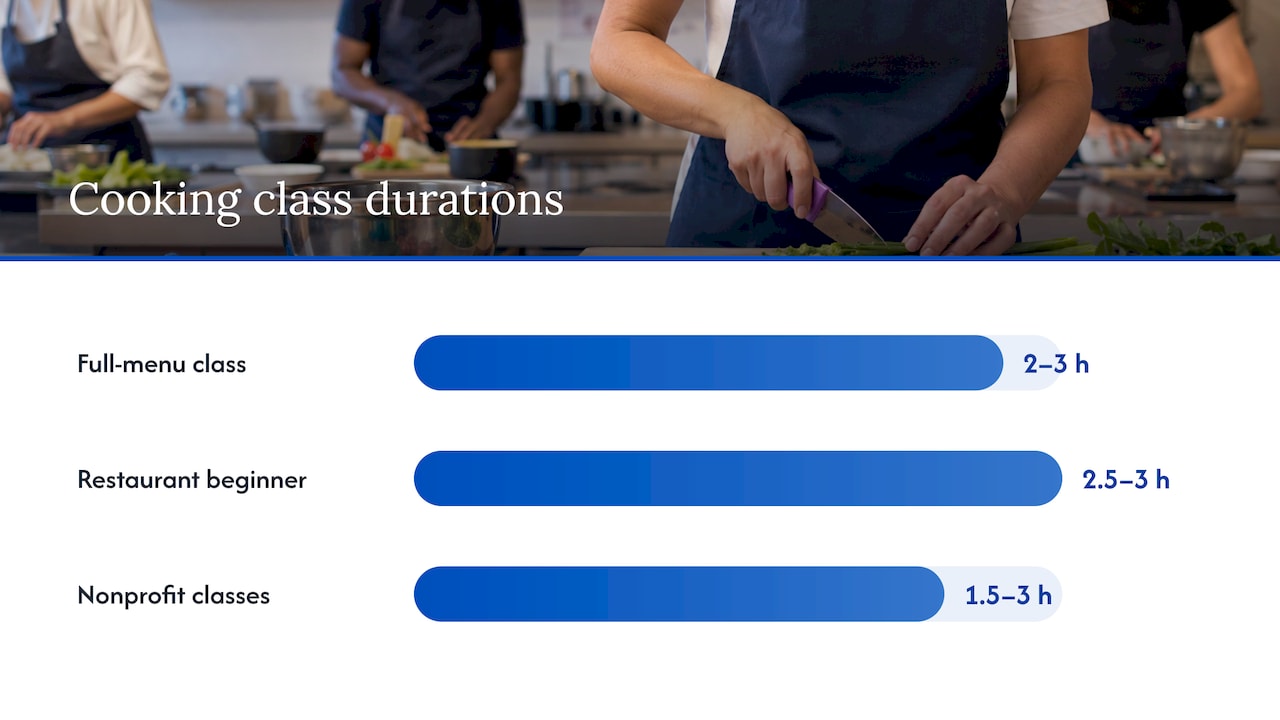
- A typical in-person class for adults runs roughly 2 to 3 hours, from the welcome to the last bite. One U.S. nonprofit’s classes, for example, run 1½ to 3 hours depending on the class.
- Live online classes tend to be tighter, often 90 to 120 minutes.
- Date nights and team events are built around the meal, so expect the sit-down at the end to be part of the schedule.
- Kids’ camps are measured in days: a daily block plus a multi-day run. Always check the daily hours on the listing.
- Arrive about 10 minutes early, and plan for a little extra time after, since the best part is often lingering at the table.
Table of Contents
- So, how long is a cooking class?
- What fills the time in a typical class
- What makes a class run longer or shorter
- Date night, group and team-building classes
- Online cooking classes
- Kids’ cooking camps
- Intensive and professional programs
- How to plan around the clock
- Our perspective: why we think 2 to 3 hours is the sweet spot
- Ready to book a class that fits your schedule?
- FAQ
- Sources
So, how long is a cooking class?
The honest answer is “it depends on what you’re making,” but there is a very reliable middle. For a single-session, hands-on class where you cook a full menu, 2 to 3 hours is the range most people should plan around. A beginner-focused guide from a restaurant that runs classes describes most beginner classes as lasting about 2.5 to 3 hours, including prep, cooking and eating the meal. A published U.S. class information sheet from a food-bank nonprofit lands in the same neighborhood, with classes lasting 1½ to 3 hours depending on the class.
Why that range? Because a class isn’t only cooking. It’s a small, well-paced event with a beginning, middle and end. Chefs need time to explain what’s on the menu, show a technique, let everyone try it, and then give the group a real chance to sit down and enjoy the result. Squeeze all of that under 90 minutes and something has to give, usually the hands-on part. Stretch it past 3½ hours and energy dips.
Here is a quick reference you can use when you scan listings:
| Class type | Typical length | What shapes it |
|---|---|---|
| Single-session in-person class (adults) | 2 to 3 hours | Menu size, group size, whether you eat together |
| Date-night class for couples | 2 to 3 hours | Usually a multi-course menu and a relaxed meal |
| Team-building event | 2 to 3 hours, sometimes longer | Group size, add-ons like a welcome drink or short presentation |
| Live online class | 60 to 120 minutes | Dish complexity, how much prep you do beforehand |
| Kids’ cooking camp | Several days, with a set daily block | Age group, number of dishes per day |
| Professional or intensive training | Multi-day to multi-week | Skills covered and hours of practice |
These are planning ranges, not promises. The exact start and end time for any class is on its listing, so treat the table as a way to know what’s normal before you book.
What fills the time in a typical class
Knowing the shape of a class makes the length feel less abstract. A well-run two-and-a-half-hour session often follows this rhythm:
- Arrival and welcome (10 to 20 minutes). You check in, wash up, grab an apron and meet your chef and the rest of the group. If there’s a drink to start, this is when it happens.
- Menu walkthrough and demo (15 to 30 minutes). The chef explains the dishes, shows the key technique (how to fold pasta dough, how to sear, how to build a sauce) and answers first questions.
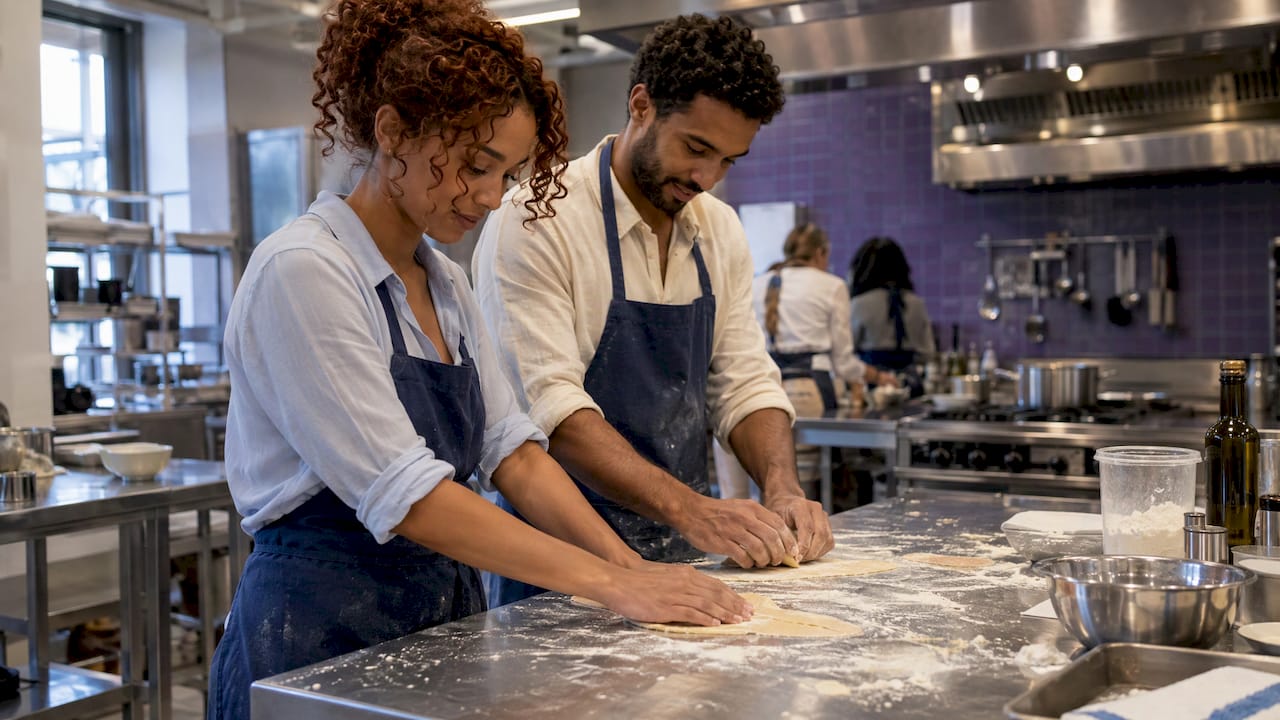
- Hands-on cooking (60 to 90 minutes). This is the core. You work with a partner or small team, chop, mix, cook and plate, with the chef moving around the room.
- Eating together (30 to 45 minutes). You sit down and enjoy what you made. In a group setting, this is where conversation really opens up.
- Wrap-up (5 to 10 minutes). Final questions, recipes, photos and goodbyes.
The percentages shift with the class. A pasta class may spend more time on dough and resting, while a stir-fry style class moves faster once the prep is done. One beginner guide breaks a roughly three-hour session into about thirty minutes of knife skills and ingredient prep, then around ninety minutes of guided cooking, which is a good picture of how the clock is spent.
What makes a class run longer or shorter
Two classes can both be called “a pasta night” and still differ by an hour. These are the factors that move the number:
Menu size and technique
A single dish, such as fresh pasta with one sauce, fits comfortably into a shorter session. A three- or four-course menu with a starter, main and dessert needs the full three hours, because every course has its own prep, cooking and plating. Techniques that involve waiting (dough rests, simmering, proofing) also add time, even when the chef cleverly overlaps them.
Group size
Small groups move faster. Everyone gets to a station sooner, the chef can check each team quickly and cleanup is easier. Large corporate groups need a little more room in the schedule for instructions, rotating through stations and getting everyone seated at the same time. If you’re planning a team event, build in extra buffer rather than squeezing it between two meetings.
Skill level
Beginner classes tend to run toward the longer end of the range, because the chef is teaching fundamentals like holding a knife safely and controlling heat. Experienced cooks often move faster through familiar steps, which is why classes pitched at them may focus on more advanced dishes rather than finishing earlier.
Whether the meal is part of the class
This is the one people forget. In most experiences built around social cooking, the meal is the finish line, and 30 to 45 minutes at the table is part of the booked time. If a listing says “cook and dine,” count the dining. If it’s a pure skills workshop where you take food home, the clock may stop sooner.
Add-ons
A welcome drink, a short presentation for a corporate group, a toast for a celebration or a photo moment all add minutes. They’re worth it, but they are why a team event can run a bit longer than a standard class on the same menu.
Date night, group and team-building classes
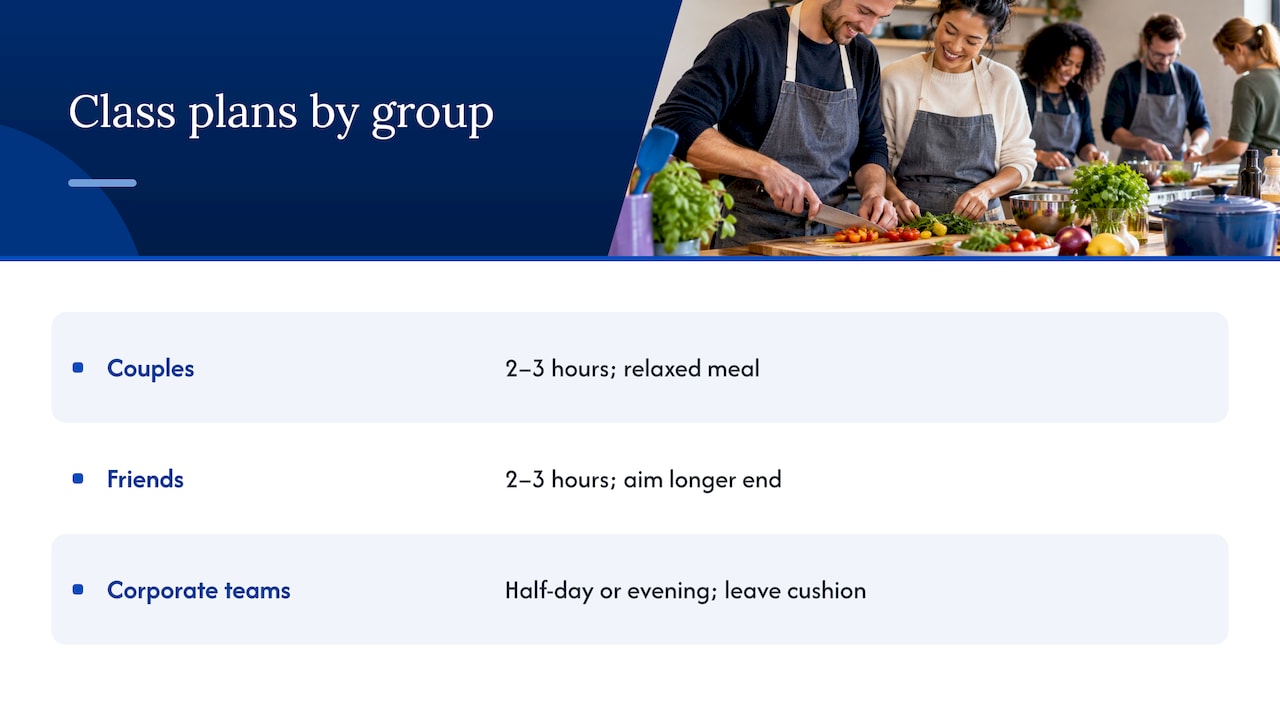
For couples, 2 to 3 hours is the sweet spot. It’s long enough to cook something you’d be proud to serve at home, and short enough that it still feels like an evening out rather than a project. The best date-night classes keep the pace relaxed: you cook side by side, there’s room for laughing at your own knife work, and you sit down to eat while it’s still hot.
For friends and celebrations, the same window works, with a bit of slack for chatting. Birthday groups and bachelorette-style outings usually don’t want to rush the table, so aim for the longer end and don’t schedule anything right after.
For corporate teams, think about the whole block rather than the class alone. Add arrival time, any welcome remarks and the time it takes a larger group to settle at the table. A cooking event works well as a half-day afternoon activity or an evening after a meeting, and you’ll want to leave a cushion at the end so no one is watching the clock. If you’re comparing options, our group cooking classes in New York City and Group Cooking Class in San Francisco Bay Area pages are good places to see how team events are set up in each city.
When you book, ask yourself three things: How many people are coming? Is the meal included in the time? Do we want a drink or a short toast first? Those answers tell you whether to plan for the shorter or longer end.
Online cooking classes
Live online classes generally run shorter than in-person ones, because you’re cooking in your own kitchen and you don’t need travel, check-in or a shared sit-down. One roundup of online options notes that live classes from a major cookware retailer run between 90 and 120 minutes, and a marketplace of shorter experiences is listed there as 1 to 2 hours long. That’s a useful benchmark for what to expect.
A few practical notes for online sessions:
- Do your prep first. Many classes send an ingredient and equipment list ahead of time. Chopping onions on camera takes longer than you think, so having things measured and ready keeps you with the group.
- Plan for the meal. You’ll likely eat in your own home afterward, so allow 20 to 30 minutes past the stated end if you want to enjoy it hot.
- Group sessions run a touch longer. A team joining from several locations needs a few minutes at the start for audio checks and introductions.
If you’d like to try cooking with a chef from your own kitchen, take a look at our online cooking classes.
Kids’ cooking camps
Camps are a different measurement entirely. Instead of asking “how many hours,” ask two questions: how long is each day, and how many days does the camp run? Summer and holiday camps are usually structured as a daily block with a few dishes per day, repeated across several days, so kids can build skills as the week goes on. Exact hours differ by camp and age group, so check the listing for pickup and drop-off times before you plan your work schedule.
Parents often find that a multi-day camp works better than a one-off class for younger kids. The first day is about getting comfortable with the kitchen, tools and safety rules; by day three, they’re confidently measuring, stirring and plating. If your child is brand new to cooking, look for a shorter daily block with plenty of breaks, and for older kids, a longer day with more complex dishes can keep them engaged.
To see what’s currently on offer, our Summer Kids Cooking Camp is listed on our main site, and the listing has the schedule for the current season.
Intensive and professional programs
Sometimes “cooking class duration” really means “how long will it take to learn this properly?” A single evening is a great introduction, but if you want career-level skills, programs stretch much longer. Short intensives are measured in days; a 5-day, 40-hour intensive culinary course is a good example of how much ground you can cover when you commit a focused week. We also list a Professional Pasta-Making Class: 3-Day Training Program for people who want to go deep on one craft.
And if you’re not sure yet? A classic piece of advice from a New York Times look at Manhattan cooking schools was that beginners who are unsure should start with a less expensive, less thorough course and commit more time and money once their confidence grows. It’s older guidance, but it holds up: take a single class first, see how you feel after three hours, and then decide whether a multi-day program is for you.
How to plan around the clock
A little planning makes the length feel like a gift rather than a constraint.
- Arrive early. Class information from one U.S. food-bank program asks participants to arrive 10 minutes before the start. It’s a good habit for any class: you’ll check in calmly, pick a station and be ready when the chef begins.
- Leave a buffer after. Add 30 minutes at the end. Groups love to keep chatting, and you don’t want to leave mid-conversation.
- Eat lightly beforehand. If the class includes a full meal, you’ll enjoy it more. For an evening class, a small snack in the afternoon is plenty.
- Confirm what’s included. Check whether dining, drinks and cleanup are part of the stated time.
- Match the length to the group. Couples and small friend groups can go long; larger teams do best with a schedule that has a clear end time.
- Plan transport. If you’re in a city like New York or San Francisco, factor in travel time so you’re not rushing to check in.
If you’re thinking more broadly about what makes a food outing feel special, this look at what a culinary experience involves is a nice companion read for planning the sensory side of the evening.
Our perspective: why we think 2 to 3 hours is the sweet spot
We’ve built our experiences around people connecting over food, and that shapes how we think about time. A class that rushes the table feels like a lesson. A class that gives you room to cook, taste and talk feels like a memory.
That’s why we like the 2 to 3 hour format for date nights, friends’ gatherings and team events. It gives a chef enough time to teach essential techniques properly, lets everyone get their hands on the food, and leaves space to sit down and enjoy the dishes together. When you’re cooking pasta, Thai or any other cuisine with an expert chef beside you, those hours go quickly.
For people who want to go deeper, we offer longer formats too, from kids’ camps that run across several days to professional training. And for teams, we like to plan the full event around the people in the room, not the other way around, so the schedule works for your group.
Our advice: choose the length that matches the mood you want. Short and lively for a weeknight, longer and slower for a celebration.
Patta
Ready to book a class that fits your schedule?
Whether you want a relaxed date night, a team event that people actually look forward to, or an online session from your own kitchen, we have hands-on options led by expert chefs in New York, San Francisco, Los Angeles, Boston and Hong Kong. Each listing shows its schedule, so you can pick a time that works. Browse our classes and book an experience, or look at our group classes in New York if you’re planning something for a larger crowd. A digital gift card is an easy way to let someone else choose their evening.
Planning a private gathering instead? Our private dinner experiences and event spaces are worth a look, and teams can see what hosting a bigger event involves on our corporate cooking page.
FAQ
How long is a typical cooking class?
Most in-person classes for adults last about 2 to 3 hours, including the time you spend eating the meal. Published U.S. class information shows a similar spread, with one program’s classes running 1½ to 3 hours. The listing for your specific class will give the exact start and end time.
Is the meal included in the class time?
In most social, cook-and-dine experiences, yes. The sit-down at the end is part of the schedule, usually 30 to 45 minutes. Check the listing to confirm, especially if you need to leave at a specific time.
How long is an online cooking class?
Live online classes commonly last between 60 and 120 minutes. A roundup of online options lists live classes of 90 to 120 minutes. Allow extra time to prep your ingredients and to eat afterward.
How long is a kids’ cooking camp?
Camps are usually scheduled as a daily block repeated over several days, often a full week in summer. Because the daily hours and the number of days change from camp to camp, check the schedule on the listing before you book so pickup times fit your day.
Should I arrive early for a cooking class?
Yes. About 10 minutes early is a good rule, and one U.S. program’s class guidelines ask participants to arrive 10 minutes before the start. It gives you time to check in, wash up and settle at your station.
Sources
- Free Cooking Class Information (Second Harvest)
- Your First Cooking Class for Beginners: A Full Guide
- 25 Best Online Cooking Classes to Gift Your Favorite Cook (The Kitchn)
- Cooking Schools in Manhattan (The New York Times, 1978)
- What Is a Culinary Experience? A Sensory Guide