Commissary Kitchen Requirements for Booking a Studio Space

To book a teaching or short-term commissary-style kitchen, you’ll commonly need three things right away: current liability insurance, proof of food-safety credentials when required, and a refundable damage or cleaning deposit, plus a mandatory orientation before your first use. Studios also want a confirmed point of contact who’ll be on-site and, in some cases, proof of business licensing if you’re selling tickets or products. Here’s what most rental agreements ask for:
- Liability insurance, often $1M per occurrence and $2M aggregate, with the studio added as additional insured
- Health permit, food processing license, or food-handler proof, when the event involves food production
- Completed orientation covering equipment, cleanup, and emergency procedures
- Refundable damage or cleaning deposit, paid before access is granted
Studios that request this paperwork before issuing keys tend to run tighter, safer events. Biteunite already meets this standard across its shared kitchen locations, so planners can skip the scramble and go straight to booking a class or event.
Key Takeaways
Commissary kitchen requirements come down to four commitments studios verify before handing over access: insurance, credentials, deposit, and orientation.
| Point | Details |
|---|---|
| Insurance minimums are common | Expect $1M per occurrence and $2M aggregate, with the studio named as additional insured. |
| Orientation happens before access | Studios grant keys or codes only after you complete a safety and equipment walkthrough. |
| Deposits protect against real risks | Refundable deposits typically range from $150 to $1,000 depending on package size. |
| Confirm scope in writing | Cleanup, staffing, and equipment terms should be nailed down before you pay anything. |
| Biteunite already meets these standards | Its shared kitchens bundle orientation, staffing, and cleanup scope into one booking. |
Table of Contents
- What Are the Commissary Kitchen Requirements Studios Ask For?
- How Do You Apply and Book a Kitchen Rental?
- What Are the On-Site Rules and Safety Expectations?
- What Do Commissary Kitchen Costs and Deposits Look Like?
- What Should You Confirm With Your Kitchen Provider Before Paying a Deposit?
- How Does Biteunite Simplify These Requirements for Planners?
- What Happens After Your Event Ends?
- How Long Does Booking Approval Actually Take?
- What Are Typical Capacity Limits and Staffing Rules?
- What Activities Are Typically Prohibited?
- What Do Standard Contract Terms Cover?
- Why the Paperwork Isn’t the Obstacle You Think It Is
- Book a Kitchen That Already Meets These Requirements
- Sources
What Are the Commissary Kitchen Requirements Studios Ask For?
Every rental agreement is built around proving you won’t create a liability, a health risk, or a mess someone else has to clean up. That’s the whole logic behind the paperwork. Once you see it that way, the requirements stop feeling like red tape and start feeling like a checklist you can knock out in an afternoon.
Insurance comes first. Shared kitchen programs commonly require proof of liability insurance, with $1 million per occurrence and $2 million aggregate showing up again and again as the baseline. The studio usually wants to be named as “additional insured” on your certificate, not just listed as a mailing address. If your policy is set to expire before your event date, send an updated certificate at least a week ahead. Waiting until the day of your rental to fix a lapsed policy is the single most avoidable way to lose your booking.
Health credentials depend on what you’re actually doing. A birthday dinner with a hired chef looks different from a ticketed cooking class where guests handle raw poultry. Some facilities require a Certified Food Protection Manager on-site for any food-production use, though the exact threshold varies by facility and local health code. If you’re hosting a private event rather than producing food for sale, this requirement often relaxes, but always confirm rather than assume.

Business licensing matters for vendors. If you’re charging admission, selling food, or running a recurring class series, the studio may ask for a retail or temporary event permit tied to your business entity.
Orientation is nonnegotiable almost everywhere. It typically covers stove and ventilation controls, fire suppression, and where the first-aid kit lives, and it’s usually the last step before you get keys or an access code.
How Do You Apply and Book a Kitchen Rental?
Most studios follow a similar rhythm, even if the exact names of each step differ. Knowing the sequence in advance keeps you from missing a deadline that pushes your event back a week.
- Gather your documents first. Insurance PDF, event description, headcount, and a rough equipment list. Submitting an incomplete application is the number one reason approvals stall.
- Submit an interest or application form. Many studio host pages ask you to describe your class or event and specify equipment needs before scheduling a call.
- Wait for review. Processing windows vary widely. Some programs request five business days for a decision and allow two to three weeks for full approval on more complex bookings.
- Complete orientation. This is usually scheduled once your paperwork clears, not before.
- Pay your deposit and confirm the date. This locks your slot.
Delays almost always trace back to the same culprits: an expired certificate, a missing insurance addendum, or a scheduling conflict the studio didn’t catch until late. Recurring renters or membership holders typically renew certificates annually and re-confirm orientation only when facility policies change.
What Are the On-Site Rules and Safety Expectations?
Cleanup and safety rules exist because the next renter walks in an hour after you leave. Studios that spell out expectations clearly tend to run into fewer disputes over deposits.
- Sweep and mop floors, sanitize worktops, and return communal small wares clean and dry
- Run dishwashers or three-compartment sinks per the posted protocol, not your own habit
- Sort waste correctly: compost, trash, and grease disposal are rarely interchangeable
- Label and limit refrigerated storage; leftover food left behind is a common source of fines
- Keep a designated adult present for the full rental period, with a plan for reporting incidents
Equipment rules also matter more than most first-time renters expect. Unsupervised stove use, disabling ventilation systems, or bringing in outside repair technicians without approval are common ways to void a contract. Communal equipment gets returned clean and labeled, not just rinsed.
Pro Tip: Photograph the kitchen before you start cooking and again before you leave. It takes thirty seconds and settles almost any dispute about what condition you left behind.
What Do Commissary Kitchen Costs and Deposits Look Like?
Budgeting gets easier once you know the fee structure isn’t as improvised as it looks. Most studios stack three or four charge types, and the math is predictable once you’ve seen it once.
- Application or membership fees are often nonrefundable, separate from your rental rate
- Hourly or block rates apply for cooking classes, private events, or short-term rentals
- Refundable damage deposits commonly range from $150 to $1,000 depending on package size and usage
- Cleaning fees may be flat or scaled to how much extra work the studio has to do after you leave
Deposits get withheld for the reasons you’d expect: skipped cleanup steps, lost keys, damaged equipment, or a certificate that expired before your event. Sample rental agreements often spell out that repeated violations can suspend your booking privileges entirely, not just cost you the deposit.
Cancellation terms vary, but tiered refund schedules (full refund 14 days out, partial at 7, none inside 48 hours) are common. Lock in extra staffing or equipment rentals early. Overtime billed at the door almost always costs more than overtime negotiated in writing.
What Should You Confirm With Your Kitchen Provider Before Paying a Deposit?
Send one email covering these points, and you’ll eliminate most of the surprises that show up on event day.
- Confirm the cleanup scope in writing. Who clears plates, whether beverage or alcohol service is allowed, and who supplies glassware. Vague “full-service” language is a common source of disputes, since it means different things to different studios.
- Confirm document timing. When updated insurance or permits are due, and what happens if a renewal lapses before your event date.
- Confirm equipment access. Whether specialty tools can be brought in, where they’re stored, and what’s already provided.
- Confirm logistics. Arrival time, key pickup and return, parking, and emergency contact procedures.
Booking checklists for private-chef events consistently point to the same lesson: confirming arrival time, access, and equipment in advance prevents day-of scrambling. The same logic applies to studio rentals.
Pro Tip: Ask for overtime and cancellation terms in the same email where you confirm your date. Providers respond to specific written questions far faster than vague ones sent after you’ve already paid.
How Does Biteunite Simplify These Requirements for Planners?
Biteunite runs vetted shared and cloud kitchens across its markets, with mandatory orientation and staffing processes already built into the booking, so you’re not chasing paperwork from three different departments.
- Chef instructors handle equipment and safety protocols, so your team doesn’t manage that piece
- Event-ready packages bundle cleanup scope and equipment access into one agreement
- City-specific booking pages, like the San Francisco shared kitchen space, show exactly what’s included before you commit
For corporate planners juggling five vendors on a single event, that consolidation is the real time-saver. You confirm scope once instead of negotiating it with a venue, a caterer, and an insurance broker separately.
| Point | Details |
|---|---|
| Insurance is the first gate | Most studios need $1M/$2M liability coverage with them named as additional insured. |
| Orientation happens before keys | Expect a mandatory walkthrough of equipment and safety before you get access. |
| Biteunite bundles the paperwork | Chef instructors and event packages fold cleanup and equipment scope into one booking. |
What Happens After Your Event Ends?
Post-use responsibilities are where deposits get won or lost, and most disputes trace back to a step someone assumed didn’t apply to them. The cleaning checklist typically covers three zones: cooking surfaces, floors, and shared equipment. Worktops get sanitized, floors get swept and mopped, and any communal pots, pans, or small wares go back exactly where they came from, clean and dry.

Waste sorting trips up more renters than any other step. Compost, trash, and grease disposal usually have separate bins or containers, and mixing them is one of the fastest ways to trigger a cleaning fee. Leftover food is its own category: some studios allow short-term refrigerated storage with a labeled container and pickup deadline, while others require everything to leave with you the same day.
Lost keys carry real financial weight. Rekeying a commercial facility costs more than a home lockset, and many contracts pass that cost directly to the renter, sometimes as a flat fee written into the agreement, sometimes billed at actual cost. If you’re issued a physical key or fob, treat it like a security deposit in your pocket. Report a loss immediately rather than hoping it turns up, since studios that discover a missing key days later tend to escalate rekeying costs and may add a delay before your next booking is approved.
How Long Does Booking Approval Actually Take?
Timelines depend heavily on how complete your first submission is. A studio reviewing a clean application with insurance attached moves fast. One missing document can add a week or more to the process.
Expect an initial response within a few business days for straightforward requests, longer for first-time renters who need a full orientation scheduled before approval. Recurring events or membership-style arrangements move faster after the first booking, since your insurance and orientation status stay on file.
Give yourself more runway than feels necessary, especially for a first booking. A comfortable planning window is three to four weeks out for a single event, longer if your certificates need renewal or your event involves outside vendors who also need to be added to the insurance certificate. Corporate planners booking around a fixed date, a product launch or a quarterly offsite, should treat the studio’s approval window as a hard deadline on their own internal timeline, not a flexible buffer. Submitting your interest form the same week you lock a venue date is common, but submitting it the same week as the event itself is the fastest way to get turned down for reasons that have nothing to do with your event’s quality.
What Are Typical Capacity Limits and Staffing Rules?
Capacity limits aren’t arbitrary. They’re set by fire code, kitchen layout, and how many people can safely move around active cooking stations without someone getting burned. A space that comfortably teaches twelve people a pasta-making class might cap at twenty for a standing reception with no active cooking.
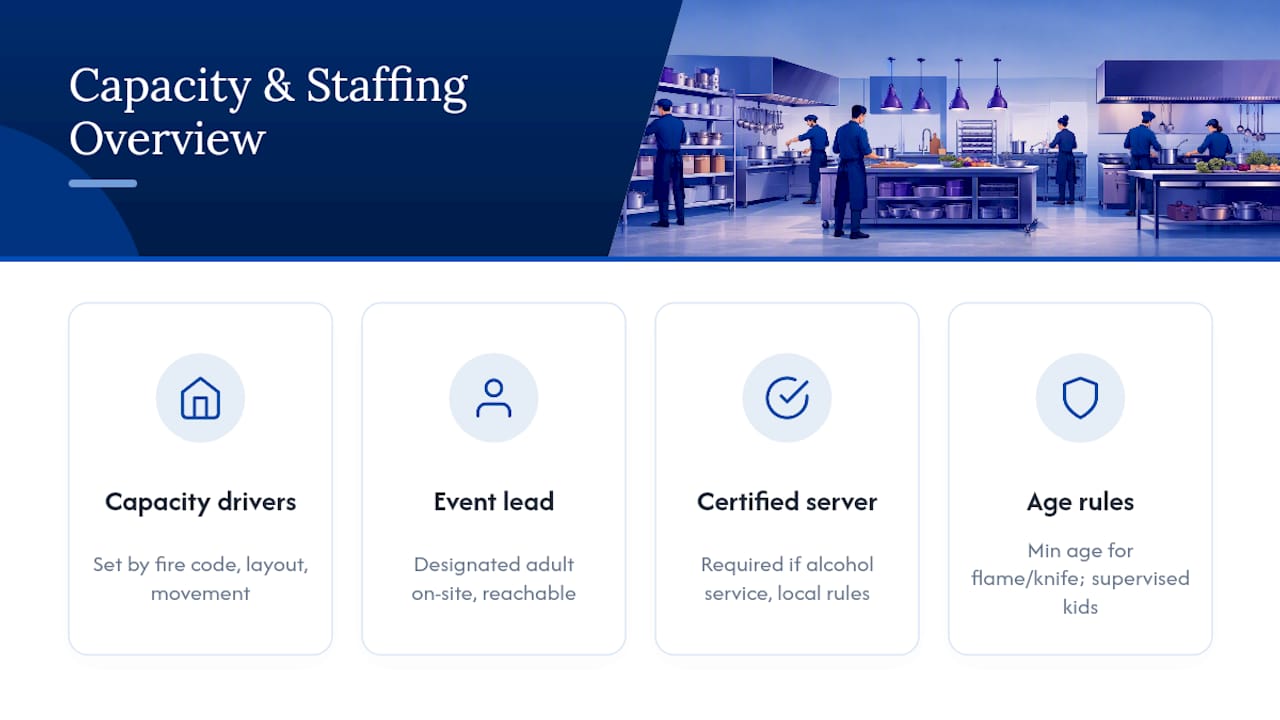
Staffing expectations follow a similar logic. Most studios require a designated adult host or event lead present for the entire rental period, someone who can be reached immediately if an issue comes up. For classes involving alcohol service, a certified server may be required depending on local rules. Age restrictions vary by activity: many studios set a minimum age for hands-on cooking stations involving open flame or knives, though supervised kids’ programming is often handled separately with its own staffing ratio.
Corporate teams booking a large group should confirm capacity against their actual attendee count before finalizing, not their optimistic estimate. A studio that approves your booking for forty people won’t renegotiate the day-of when fifty-five show up.
What Activities Are Typically Prohibited?
Every rental agreement includes a short list of things you simply can’t do, and most of them exist because someone tried it before you. Unsupervised stove or oven use by anyone who hasn’t completed orientation tops the list at nearly every facility. So does disabling or blocking ventilation hoods, which sounds obvious until someone does it to reduce noise during a class.
Bringing in outside contractors to repair or adjust kitchen equipment is almost universally banned, since it creates liability the studio’s own insurance doesn’t cover. Subletting your rental slot to another group without approval, exceeding your approved headcount, and using the space for activities outside your stated purpose (a cooking class booking suddenly becoming a full dinner party with an open bar) also show up as standard violations.
Smoking, open flame outside designated cooking equipment, and bringing in personal pets are typically prohibited outright. None of these restrictions are unusual once you’ve seen a few contracts side by side. They’re the same handful of common-sense rules, worded slightly differently by each facility.
What Do Standard Contract Terms Cover?
A typical kitchen rental agreement reads like a shorter, more specific version of any commercial lease. It opens with the rental period and rate, moves into insurance and permit requirements, then spells out cleanup obligations, deposit conditions, and cancellation terms.
Look for language covering three things specifically: what counts as damage versus normal wear, how disputes over deposit withholding get resolved, and what happens if either party needs to cancel. Contracts that leave “full service” or “standard cleanup” undefined create more disputes than contracts that spell out every task, since explicit language about who does what tends to hold up better than vague promises when something goes wrong. Force majeure clauses, covering things like extreme weather or facility closures, are worth asking about even though most renters never think to raise the topic until they need one.
Why the Paperwork Isn’t the Obstacle You Think It Is
Most planners treat the requirements list as a barrier to get through as fast as possible. That’s backward. The studios with the clearest paperwork requirements are almost always the ones that run the tightest, safest events, and a rushed or incomplete application is the single biggest predictor of a bad experience once you’re actually in the kitchen.
The conventional advice tells you to “get your documents ready.” That’s incomplete. What actually matters is sequencing: insurance before application, orientation before keys, written scope before deposit. Skip the order and you’ll spend your event week chasing signatures instead of prepping ingredients.
If there’s one thing worth prioritizing first, it’s getting the cleanup and staffing scope in writing before you pay anything. Vague terms like “full service” cause more disputes than any insurance technicality ever will. A studio that hands you a clear, itemized agreement upfront is telling you something real about how it operates. A studio that waves off your questions is telling you something too.
— Patta
Book a Kitchen That Already Meets These Requirements
Chasing insurance certificates, scheduling orientation, and negotiating cleanup scope with three different vendors takes real time, time most planners would rather spend on the actual event. Biteunite removes that friction by running its own vetted shared kitchens, where orientation, staffing, and equipment access are already built into the booking instead of something you have to assemble yourself.

That matters most for corporate teams booking a one-time offsite or a couple planning a private class, since neither wants to become a part-time facilities coordinator just to lock in a date. Biteunite’s chef instructors handle the technical scope, and city pages like the Manhattan team-building page and the San Francisco group class page show exactly what’s included before you commit to anything. Check availability for your city and get a straightforward quote back the same week, without the back-and-forth over certificates and cleanup terms this article just walked you through.
Sources
- Chelan-Douglas Community Action Council kitchen rental page
- CCE Tompkins kitchen rental application and rules
- Private Chef Booking Checklist - Platesfull
- MSP Kitchenery kitchen rental requirements















































































.webp)